


Katharine Hillard
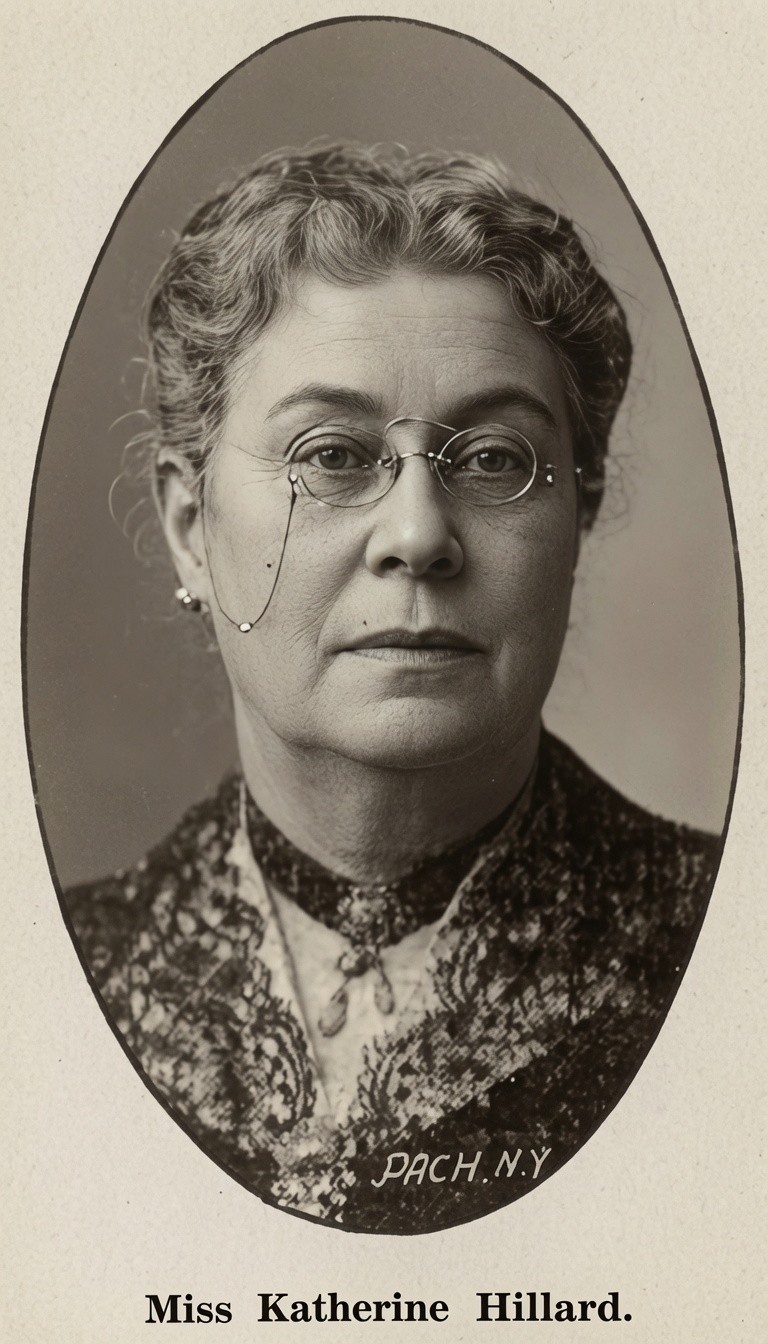
One of the most influential workers in the theosophical movement, certainly under the Judge administration, was Katharine Hillard. She was also perhaps the most underappreciated worker for the Theosophical Cause by other theosophical organizations. She was a well-respected scholar in academic realms but has been given very little recognition for her understanding of theosophical teachings.
Katharine was born in London, England on March 10, 1839. Her parents were John H. Hillard, a merchant, and Harriet Low, the daughter of Seth Low, grandfather of Seth Low who became an important American public figure. He served as Brooklyn’s mayor (1881-1885), as president of Columbia University (1890-1901) and as the 93rd mayor of New York City (1902-1903). He also served as a diplomatic representative of the United States to the International Peace Conference at The Hague in 1899. Interestingly, Ernest T. Hargrove, who had recently resigned as president of the then Theosophical Society in America, was also in attendance. As a result, Hargrove was hired to go the South Africa to mediate the South African War, better known as the Second Anglo-Boer War. Hargrove and Seth Low knew each other thanks to Katharine Hillard.
Hillard’s parents were of New England stock and had migrated to London. In 1848 the family returned to America and made their home in Brooklyn. Katherine’s early education was obtained in private schools which then made a specialty of foreign culture. She furthered her education in French and Italian by studying in Europe. After spending four winters in Italy studying Dante and the mysticism of the middle ages, she visited H.P. Blavatsky in London in May 1888. She wanted to stay in London and study theosophy under Blavatsky with whom she had spent two or three evenings. Blavatsky had other ideas. Hillard wrote: “She advised me to settle neither in Rome nor London, but to return to New York. ‘You could not do better,’ she said in her emphatic way, ‘than to go back to New York, and study with W. Q. Judge. He is a good man.’ Never shall I forget the stress she laid upon those words, as if to answer the attacks she doubtless foresaw.” [TQ 7, July 1909, pp.59-61]This is an interesting quote that can only be fully appreciated after reading her writings. Hillard applied for membership on December 14th, 1888 and was admitted to the Aryan T.S. on the 18th, where she became an indispensable worker.
Katharine Hillard was best known among academics as a very distinguished Dante scholar. “As a successful writer, she had won a reputation for careful research, for sound judgement, for trustworthy craftsmanship.” [TQ 13, Jan. 1916, p.221]She published translations from the foreign classics, among them being an English version of Dante’s Convito. Her translation of The Banquet (Il Convito) of Dante Alighieri (Kegan Paul, Trench & Co., London, 1889) is considered one of the best.
Footnote: The Convivio is a kind of vernacular encyclopedia of the knowledge of Dante's time; it touches on many areas of learning, not only philosophy but also politics, linguistics, science, astronomy, and history. [https://en.wikipedia.org/wiki/Convivio]
Under Judge’s tutelage and her commitment to theosophy, she wrote profound and succinct articles which are beneficial to students today. She also contributed numerous poems and articles to various magazines which illustrated her deep knowledge of the underlying theosophical concepts. A partial list of her works includes:
“Why I Became a Theosophist”
“Hurry” – a paper read before the Aryan TS, Seventh Annual American Section, 1893.
“A Primer of Theosophy” – first serialized in the Theosophical Quarterly then published by The Quarterly Book Department as a small pamphlet.
Evolution According to Theosophy, in Two Parts: Part I. Evolution of the Earth; Part II. Evolution of the Races.
“At the Gate of Death” – explores the concepts of life and death.
“The Mystery of the Eighth Sphere” – what it means to live the wicked life.
“The Black Madonna of Loreto”
“The Easter Hare” – reveals Easter as the Lord of Light and Conqueror of Darkness; ‘sign of new life and the messenger’
“Hawthorne as an Interpreter of New England”
“The Beatrice of Dante: From a Theosophic Point of View”
An Abridgment to the Secret Doctrine
“The Lessons of a Noble Life”. A paper read on the last day of the Second Annual Convention of The Theosophical Society in America,1896, on the life of W.Q. Judge.
Poems:
“My Sparrows”
“Fancy’s Masquerade”
“The Brook’s Message”
“An Egyptian Allegory (From ‘The Book of the Dead’)”
Shortly after her death the editor of Theosophical Quarterly wrote the following:
[O]n coming back to the United States, Miss Hillard volunteered for regular service with Mr. Judge. . . . . [I]n the days immediately following the attacks on Mme. Blavatsky, made first in India, and afterwards repeated in London, . . . a cloud of obloquy rested on the Theosophical Society and on everyone actively connected with it. . . . it was not “respectable” to be a Theosophist; it was especially perilous for anyone depending . . . on the reputation that is needed for successful intellectual work. This was Miss Hillard’s position. . . . [that] she knowingly and most willingly risked — and to some degree lost — by her determination to work openly and methodically with Mr. Judge, a resolution which she courageously carried out, reading valuable papers before the Aryan Theosophical Society, of which Mr. Judge was President; and contributing to his magazine The Path, articles generally signed in full; sometimes initialed only. . . . so long as she was able, under the burden of gathering years, Miss Hillard continued to work. And, when external work became impossible for her, she gave of the treasurers of her heart.
Katherine Hillard died of pneumonia at her home in Manhattan on November 3rd, 1915. She was survived by two sisters.
